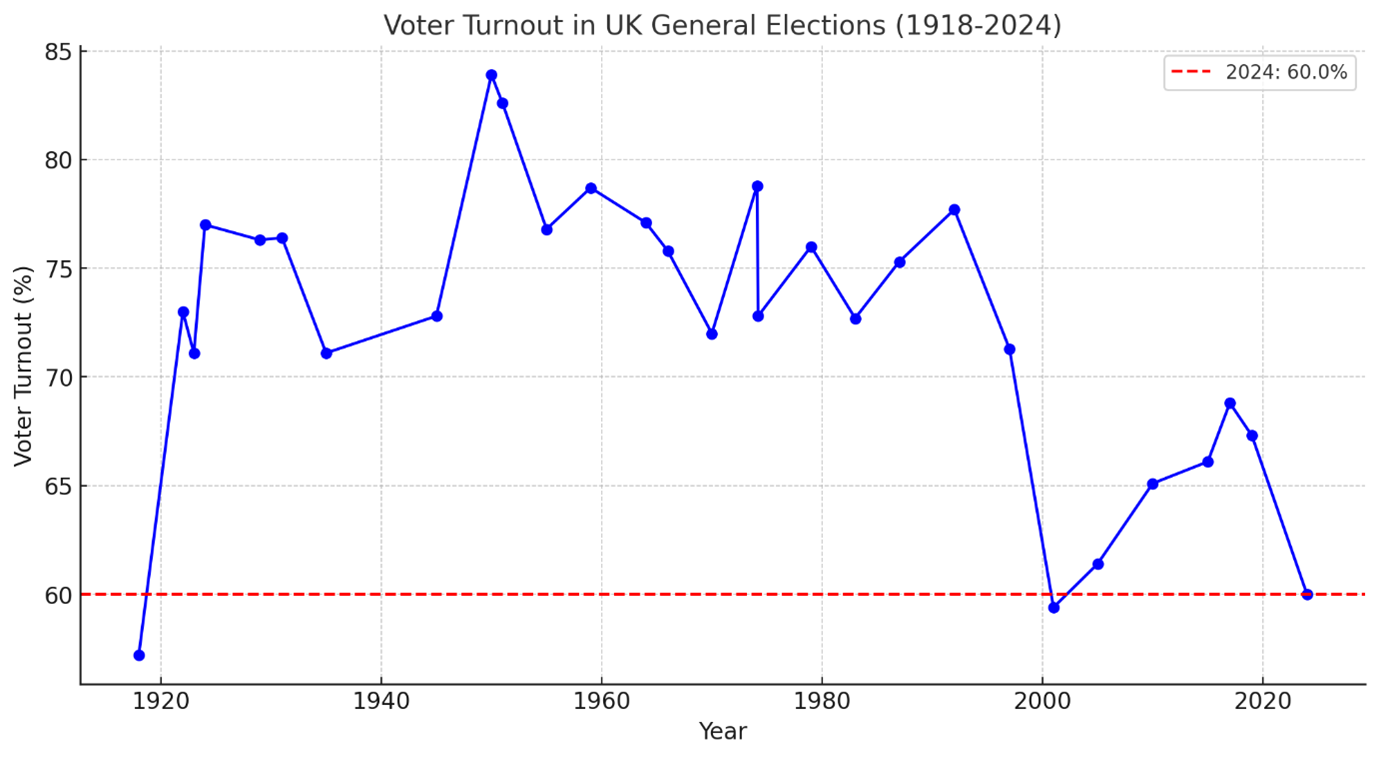
On Thursday, 4th July, 2024, the UK went to the polls to decide the next 5 years of governance. Well, 60% of the country did, the third-lowest turnout in 106 years. Only beaten by 59.4% in 2001 and 57.2% in 1918.
Labour’s new victory is nothing short of historic. Not only have they returned to power for the first time in 14 years, but they have done so with a significant majority. They captured 34% of the vote. Indeed, 34% of the 60% turnout, meaning just around 20% of the UK, actually voted for this new government.
Regardless of how we got here, industries across the country are finding stability in the clarity of government. The ‘humming and harring’ over whose policies will actually come into play is over, and for the most part, we are back to business as usual.
At Scala, we specialise in PR and marketing for legal, healthcare, and professional services, and these sectors could face some significant changes over the next five years. Labour has hit the ground running, but where are they taking us?
The Legal Sector
The legal sphere is watching Prime Minister Sir Keir Starmer closely thanks to his keen knowledge of legislation and the UK court system. He became a barrister in 1987, after all, and was appointed Queen’s Counsel in 2002. Sir Keir served as a legal officer for the campaign group Liberty until 1990 and was a member of Doughty Street Chambers from 1990 onwards. The new PM went on to achieve some of the highest roles in the UK's legal system, as in July 2008, Sir Keir became the head of the Crown Prosecution Service (CPS) and Director of Public Prosecutions (DPP). He was known for his focus on human rights in the legal system and in 2011, he introduced reforms that included the "first test paperless hearing". During his tenure, Starmer handled several significant cases, including the Stephen Lawrence murder case.
With a background like this, the UK should expect many legislative changes over the next 5 years. Prime Ministers, depending on their personalities and backgrounds, often focus on one aspect of the political quagmire to really get to grips with. For our previous incumbent, Rishi Sunak, a former analyst for investment banker Goldman Sachs, it’s no surprise his efforts poured into ‘balancing the books'—tackling inflation and boosting GDP.
Sir Keir’s specialism? It could be a legislative change. The legal industry will want to watch closely, as issues he has promised to, for lack of a better word, reform are the UK’s Brexit deal with the EU, cutting the red tape on immigration, and restoring the ‘broken’ NHS.
Sir Keir has dredged up Brexit negotiations from the bottom of the North Sea, promising to end the acrimony between the UK and EU following the 2016 referendum. Before his desk chair even got warm, he was on a chain call to world leaders, telling German Chancellor Olaf Scholz that he wanted “greater economic cooperation.” He doubled down on this aim when he punched in +33 for France, telling President Emmanuel Macron they “shared priorities, including migration and the economy.” The following day, less than 24 hours after his installation, the new Foreign Secretary David Lammy catapulted himself over to Berlin in order to “reset our relationship with our European friends and allies.”
For immigration, Rishi’s Rwanda plan has already been tossed into the garbage pile of history. However, don’t expect the Labour government to do nothing about this highly charged subject. For one, Tony Blair has reemerged, warning Sir Keir to come up with a plan for controlling immigration to turn the tide on populism and combat the political threat posed by Reform, which achieved 4 million votes, more than the Liberal Democrats.
Healthcare
The leader’s debates on the subject of the NHS were a sad indictment of its current state. It was one of the few, if only, things Labour and the Tories agreed upon—it’s broken. The question is: how will Labour bring it back to the global envy it once was? Wes Streeting, the new health secretary, agrees as well, telling his new department to consider it “broken” mere hours after his new appointment.
However, it doesn’t appear to just be all defeatist talk for our new gallery of ministers. In the youthful hours of Streeting’s front bench position, he spoke to the British Medical Association (BMA), which represents thousands of NHS medics. He said he wanted to restart talks in an attempt to end a long-running pay dispute with junior doctors. The BMA continues to demand a 35% pay rise to make up for what it says are 15 years of below-inflation hikes. It’s worth noting that Sir Keir has already slapped the BMA’s hand, outright saying their demands will not be met. Time will tell how this plays out.
Streeting will be learning the ropes of his role as he goes, but he isn’t alone anymore. Understanding that his new cabinet is rather green (pun intended), a natural consequence of being out of government for 14 years, Sir Keir has drafted in the old guard to whip the youngsters into shape. Tony Blair’s former Health Secretary, Alan Milburn, is back, assisting Streeting as he eases into the position. It’s worth noting that it was Milburn that introduced NHS Foundation Trusts, many of which have been struggling in recent years, particularly when it comes to maternity.
Blair? Milburn? Ed Miliband as Net Zero Secretary? If Blair’s premiership was New Labour, perhaps Starmer’s is Classic Labour.
Related News

Thu 9th Jul, 2026
We're hiring a Marketing Executive

Fri 26th Jun, 2026
Scala Receives Chambers Ranking for Second Consecutive Year


Tue 16th Jun, 2026
Scala Host Bespoke PR & Media Interview Training Course

Fri 5th Jun, 2026
Delivering the SCIL Conference 2026


Tue 6th Jan, 2026